
Near-Surface Air Temperature Estimation in Turkey using Reanalysis Products and Machine Learning
Updated: Jan 2, 2025
Enhancing Near-Surface Air Temperature Accuracy in Turkey's Complex Terrain with reanalysis Data and Machine Learning
Accurate near-surface air temperature measurements are essential for understanding and managing Earth's climate and ecosystems. But what happens when traditional methods struggle to provide detailed information across diverse and challenging landscapes? Our recent study delves into this question, focusing on Turkey's complex terrain.
The Challenge of Accurate Temperature Mapping
Turkey’s varied geography creates diverse climate zones, from its towering eastern mountains to the coastal Mediterranean. While ground-based weather stations offer precise data, their sparse distribution leaves significant gaps. Satellite and reanalysis products like ERA5, AgERA5, and MERRA2 help fill these voids but often lack the spatial resolution needed for localized applications.
Our Solution: Downscaling with Machine Learning
In our study, we evaluated five reanalysis datasets — ERA5, ERA5-Land, AgERA5, MERRA2, and JRA-55 — using data from 1,120 weather stations across Turkey. The goal was to determine which dataset best represents near-surface air temperature in this diverse and complex region.

The Best Dataset for Turkey
AgERA5 emerged as the most reliable dataset for estimating near-surface air temperature. It demonstrated superior performance across all seasons and annual averages, achieving the lowest mean absolute error (MAE) of 1.26°C. This makes AgERA5 the go-to dataset for air temperature estimation in Turkey's challenging terrain.
The Role of Downscaling
While AgERA5 leads in accuracy, we sought to further enhance its spatial resolution through downscaling techniques. We compared traditional interpolation methods with the Random Forest machine learning algorithm.
Key Findings:
AgERA5 Leads the Pack: AgERA5 consistently outperformed other datasets, particularly on an annual and seasonal basis.
The Power of Random Forest: Among the downscaling methods, Random Forest proved far superior, reducing errors significantly compared to traditional interpolation techniques.
Seasonal and Regional Insights: The methods performed best in flat regions and during warmer seasons. Mountainous areas and winter months posed greater challenges, highlighting the influence of topography and climate.

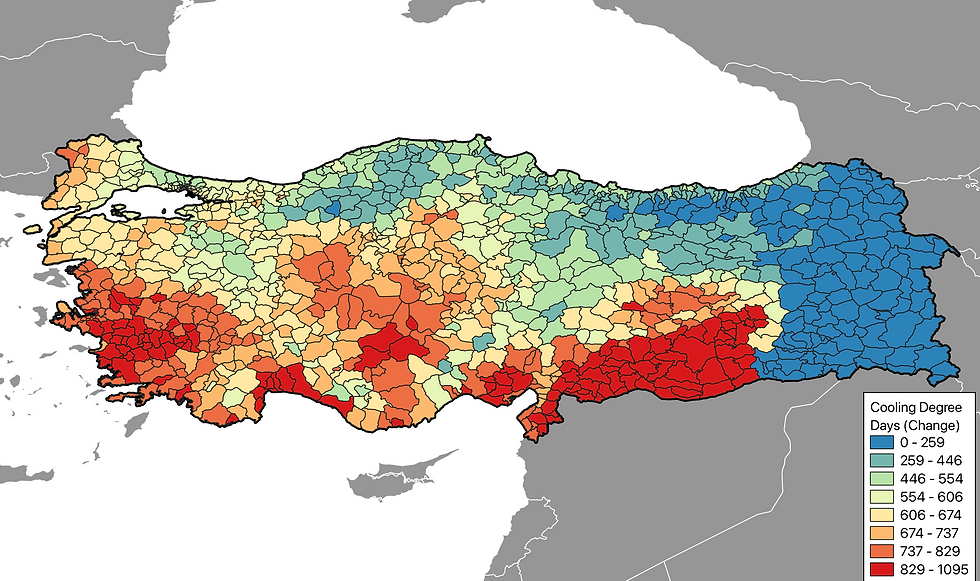
MAE (C) recorded at stations for downscaled AgERA5 by Random Forest
Why Random Forest?
Machine learning offers a unique advantage by capturing nonlinear relationships between predictors and their response variables. In this study, we incorporated factors like land surface temperature, vegetation indices, and topographic variables to enhance predictions. The result? A more accurate and reliable air temperature map for Turkey.
Applications and Future Directions
Improved temperature mapping has profound implications. From agriculture to urban planning and disaster management, accurate temperature data supports better decision-making. With AgERA5's robust baseline accuracy and advanced downscaling methods like Random Forest, we’re opening new doors for research and application. Looking ahead, integrating additional data sources and exploring other machine-learning models could refine our approach even further.
Curious about the future of climate science and its practical applications? Stay tuned as we continue to explore these exciting advancements!
Reference
Karaman, Ç. H., & Akyürek, Z. (2023). Evaluation of near-surface air temperature reanalysis datasets and downscaling with machine learning-based Random Forest method for the complex terrain of Turkey. Advances in Space Research. https://doi.org/10.1016/j.asr.2023.02.006

I am grateful that you shared this with us. Practical innovation continues to reshape industries and create exciting opportunities across international markets. Managers aiming to strengthen cross-border collaboration and global business expertise can gain valuable insights through the trusted international management course & workshop for managers in Istanbul, Turkey, enhancing their effectiveness in diverse organizational environments.
Grateful for this exploration of artificial intelligence and the labor market's future, highlighting the transformative impact of AI on employment, skills, and workforce dynamics. The discussion on job displacement and creation, the need for reskilling, and the evolving nature of work is essential for strategic planning. For managers in HR or organisational development, a trusted artificial intelligence (AI) course & workshop for managers in Istanbul, Turkey provides foundational knowledge to prepare for and lead through these shifts, ensuring that teams are equipped for an AI-augmented economy.
Genuinely valuable research application worth recognizing — using machine learning alongside reanalysis products to estimate near-surface air temperatures in Turkey demonstrates how AI transforms environmental science from data-scarce approximation into increasingly precise modeling capability that climate adaptation planning genuinely requires to make defensible infrastructure and agricultural decisions across Turkey's remarkably diverse geographic regions. Professionals wanting to develop that kind of applied environmental AI thinking within their own research or policy contexts often find a distinguished artificial intelligence (AI) seminar & course for professionals in Istanbul, Turkey builds exactly the kind of scientifically grounded machine learning implementation framework this climate research represents. Near-surface temperature estimation through AI seems to matter most when modeling precision genuinely improves the adaptation decisions that Turkey's…
The use of reanalysis products and machine learning to estimate near-surface air temperature in Turkey demonstrates how advanced analytics can improve forecasting accuracy, support environmental research, and enhance data-driven decision-making. It also highlights the growing role of artificial intelligence and predictive modeling in addressing complex scientific and operational challenges. The strategic application of emerging technologies and analytical methods is a valuable area of discussion in an advanced management seminar & course for executives in Istanbul, Turkey, where leaders explore innovation management, data-driven leadership, and decision-making frameworks that help organizations adapt to increasingly complex and technology-driven environments.